
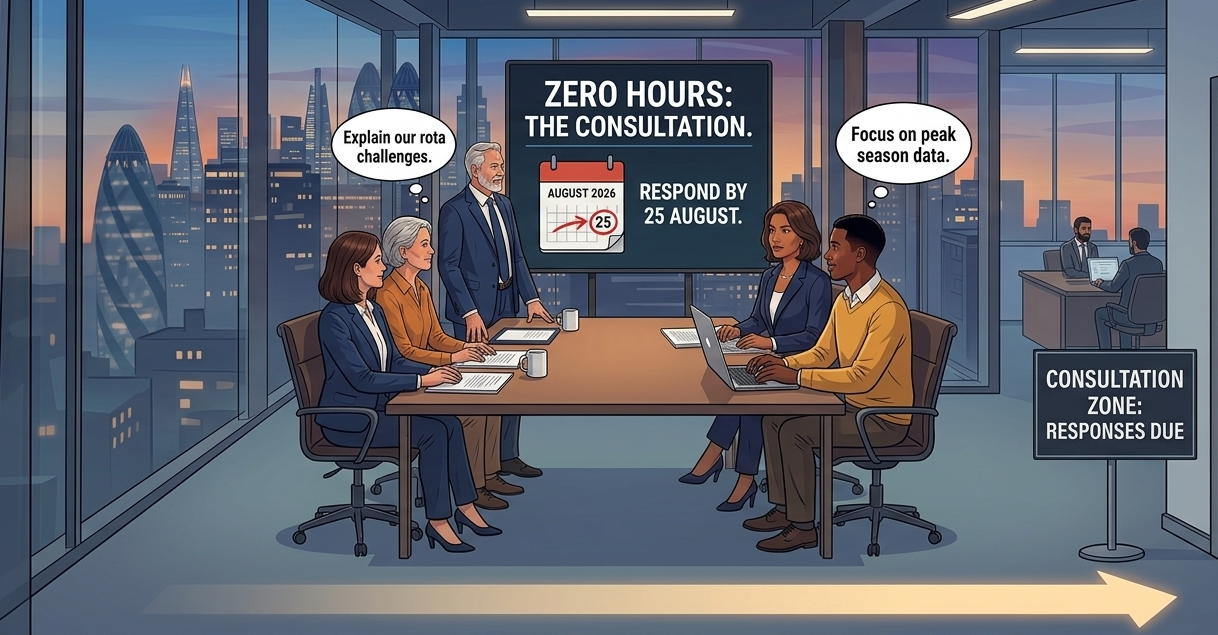
The government’s consultation on guaranteed hours, shift notice and cancellation payments closes at 11:59pm on 25 August 2026. That is twenty days from today.
Most consultations are worth skimming. This one is worth twenty minutes of your time, because of an unusual feature: the argument about whether these rights should exist is over. The Employment Rights Act 2025 settled it. What is still genuinely open is the arithmetic — and the arithmetic is where your rota either survives or does not.
The Act is Done. The Numbers Are Not.
Three rights arrive, expected in 2027, for workers on zero-hours and qualifying low-hours contracts:
- A right to be offered guaranteed hours reflecting the hours actually worked over a reference period
- A right to reasonable notice of shifts and of changes to shifts
- A right to payment where a shift is cancelled, curtailed or moved at short notice
Note the word “offered”. A worker can decline and stay on their existing arrangement. Students, carers and people juggling two jobs often will. This is not a ban on flexible working patterns, and it is not a ban on zero-hours contracts.
Almost every operative detail, though, sits in regulations that have not been drafted. The consultation — eighty-three pages, published 2 June 2026 — is where those details get decided.
Four Numbers Decide How Hard This Lands
1. Where the Hours Threshold Sits
A worker qualifies if they are on a zero-hours contract, or on a contract guaranteeing hours below a threshold while regularly working above it. The options run from 8 to 48 hours a week. The government has signalled a preference for 8 to 20.
The gap between those two figures is the difference between a compliance exercise and a restructure. A 20-hour threshold pulls in a large share of part-time retail, hospitality and care staff. An 8-hour threshold pulls in a fraction of them. Run your own headcount at 8, 12 and 20 before you write a word of your response — the number you find is your argument.
2. How Long the Reference Period Is
Twelve weeks is the government’s stated preference. Twelve weeks is fine if your demand is flat. It is a problem if it is not.
3. Mean or Median
The consultation asks whether guaranteed hours should be calculated on a mean or a median average. A median strips out the distorting effect of one freakishly busy week or one dead one. If your trading pattern is spiky, this single word is worth more to you than most of the rest of the document.
4. What Counts as Short Notice
Both for the notice you must give, and for the payment triggered when you change a shift inside it. The consultation also floats aligning the qualifying threshold across the guaranteed hours and notice rights.
The Question Seasonal Employers Keep Missing
The Act already says the duty to offer guaranteed hours does not bite where a limited-term contract is reasonable — a specific task, a defined event, a genuine temporary need.
The consultation asks whether “temporary need” should be defined to cover seasonal demand.
If you run a garden centre, a holiday park, a farm, a Christmas operation, an events business or a summer visitor attraction, that question is the most consequential sentence in eighty-three pages. Answered one way, seasonal peaks stay workable. Answered another, a twelve-week reference period that straddles your peak generates offers you cannot honour in February.
If You Use Agency Labour, Read Part Three
Where an agency worker qualifies for and accepts a guaranteed hours offer, they move onto a direct contract with the hirer. Responsibility for making the offer would generally sit with the hirer, though the consultation asks whether it should sometimes fall to the agency or an intermediary.
Long-running agency placements have been the standard workaround for maintaining flexibility without headcount. That workaround is being closed. Any placement you are setting up now that runs into 2027 needs the direct-contract consequence priced in.
Enforcement is Deliberately Asymmetric
Short-notice payments are proposed to be enforceable by the Fair Work Agency under the notice of underpayment regime as well as at tribunal, on the basis that non-payment is clear and measurable. The proposed penalty is 50% of arrears, minimum £100 and maximum £5,000 per worker.
Guaranteed hours and reasonable notice claims stay with the tribunal, because they turn on judgement.
The practical read: the cash element gets policed administratively, and your record-keeping is the evidence.
How to Write a Response That Gets Read
Officials reading consultation responses are looking for operational reality they cannot get from Whitehall. Give them that and skip the rest.
Answer only the questions you have a real view on. The guidance explicitly invites partial responses. Four answered well beats twenty-eight answered vaguely.
Lead with a number. “At a 20-hour threshold, 62 of our 104 staff come into scope; at 8 hours, 11 do.” That is the sentence that gets quoted internally.
Describe one shift. A single worked example — a care rota reshuffled at 6am because someone called in sick, and what a notice rule would have meant — carries more weight than three paragraphs of principle.
Say what you want, not just what you fear. Name the threshold, the reference period and the averaging method you can live with.
Be short. Two pages of specifics lands better than ten of general concern.
And it does move the needle. Day-one unfair dismissal rights became a six-month qualifying period. Fire and rehire shifted by three months. Responses are not decoration.
What to Do Before 2027 Regardless
You do not need the regulations to start.
- Map your workforce at 8, 12 and 20 hours and see who comes into scope in each case.
- Identify your long-standing casuals. Anyone working consistent hours for months is both your clearest guaranteed hours candidate and your clearest current risk if their status is ambiguous.
- Measure your rota practice. How much notice do you really give? How often do shifts get cut or cancelled, and what happens then? Measure it now, before you have to report it.
- Reassess your agency usage with the direct-contract consequence in view.
- Fix your record-keeping. Every one of these rights stands or falls on evidence of hours worked, notice given and shifts changed. Employers who cannot produce that evidence will lose arguments they should have won.
The Strategic Read
If you use variable hours to cover real peaks, staffed by people who value the flexibility, this is an administrative burden. Annoying, survivable, mostly a record-keeping problem.
If you use zero-hours contracts instead of workforce planning, it is something else. That is the intended effect of the policy, not an accident of drafting.
Either way, twenty days.
Insightful Hub includes zero-hours and casual worker contract templates, rota and shift documentation, and practical guidance on preparing for the guaranteed hours regime. Get ahead of 2027 at insightfulhub.co.uk.
Ready to Transform Your HR Strategy?
Get expert guidance from our Fractional HR Directors to solve your people challenges and drive business growth.