
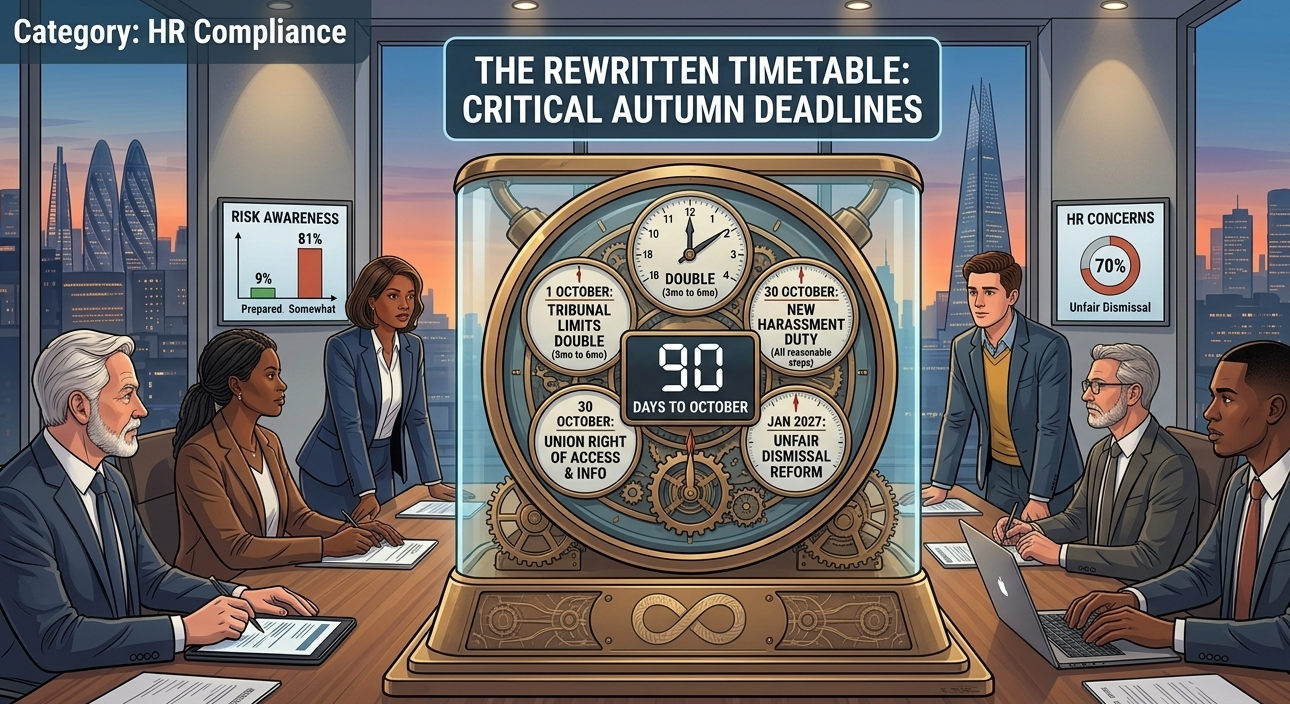
Our last post covered the autumn deadlines and flagged a date almost nobody is circling: 1 July 2026. This is the post about what happens next — and why the probation reviews you are running right now are the ones that will be read out in a tribunal.
What Actually Changes on 1 January 2027
Three things land together at the start of next year:
- The qualifying period for ordinary unfair dismissal drops from two years to six months.
- The cap on the compensatory award is removed.
- Fire and rehire restrictions commence, having been pushed back from October 2026.
Taken individually, each is significant. Taken together, they change the arithmetic of every dismissal decision an SME makes.
Under the current rules, an employee with eighteen months’ service who is dismissed badly has, in most cases, no ordinary unfair dismissal claim. From 1 January 2027, that same employee does — and there is no ceiling on what the compensatory award can be.
The remedy for unfair dismissal has always been built around actual loss: lost earnings, lost benefits, the time it takes to find comparable work. The cap has quietly been doing a lot of work in the background, particularly for higher earners and for anyone who struggles to find a comparable role. Remove it, and the exposure attached to a poorly handled dismissal is no longer a predictable number you can budget for. It is whatever the loss turns out to be.
The Maths Nobody Has Done
Work it backwards.
The reforms apply to dismissals on or after 1 January 2027. Six months before that date was 1 July 2026.
Anyone you hired on or before 1 July 2026 will have six months’ continuous service on the day the new rules take effect. They are protected from day one of the new regime. Anyone hired after that crosses the threshold at some point during the first half of 2027.
Which means: every probation period currently running in your business will conclude inside the new regime, or within weeks of it. The performance conversations you are having in August are the evidentiary record for decisions you will be making in January.
There is a technical window here — dismissals before 1 January 2027 are still judged under the current qualifying period. We would gently discourage anyone from treating that as a strategy. Rushing marginal people out of the door in December is exactly the pattern that produces discrimination claims, which have never had a qualifying period at all. Use the window to make decisions properly and on time, not to make them quickly.
Short Service Was Never the Shield You Thought It Was
Worth saying plainly, because it is the assumption underneath most sloppy probation processes: the two-year qualifying period has never covered you for the claims that actually hurt.
Discrimination claims under the Equality Act require no minimum service. Neither do automatically unfair dismissal claims — whistleblowing, trade union activity, asserting a statutory right, health and safety, and, since April this year, dismissals connected to a sexual harassment disclosure. Nor does a claim for unlawful deduction from wages, or for failure to provide written particulars.
Businesses that have relied on “they’ve only been here eight months” as a general answer have been relying on something narrower than they realised. From January, the answer stops working for ordinary unfair dismissal too.
What Goes Wrong in SME Probation Processes
In our experience, it is rarely one dramatic failure. It is six small ones:
- Probation is treated as a diary entry, not a process. Nothing happens for five months, then someone realises the end date is Friday.
- Concerns are raised verbally and never written down. The manager genuinely did have three difficult conversations. There is no record that any of them occurred.
- “Not the right fit” is used as the reason. It is not a reason. It is the absence of one. A tribunal will ask what specifically the employee did or failed to do, and against what standard.
- Probation is extended without a contractual right to extend it. Check the contract. Many SME templates do not include one.
- The probation period is confused with the qualifying period. They are separate things. Passing probation does not confer rights, and failing it does not remove them. From January, an employee on a nine-month probation will already have full unfair dismissal protection while still, contractually, on probation.
- No fair process is followed because none was thought necessary. After six months’ service, a dismissal needs a potentially fair reason — capability, conduct, redundancy, statutory restriction, or some other substantial reason — and a fair procedure. Unreasonable failure to follow the Acas Code on disciplinary and grievance matters can add up to 25% to any award. With the cap gone, 25% of an uncapped figure is a meaningful number.
What a Defensible Probation Process Looks Like
Not complicated. Just done.
A written probation clause that states the length, the right to extend, the review points, and the notice position during probation. Scheduled reviews at set intervals rather than one meeting at the end. Objectives that are specific enough to be measured. A short written note after each review, shared with the employee, recording what was discussed and what needs to change. Where performance is short, a clear statement of the gap, the support being offered, and the timescale. A final decision meeting, with the right to be accompanied offered as a matter of good practice, and written confirmation of the outcome and any appeal.
None of this requires a HR department. It requires a template and the discipline to use it.
The Compounding Effect
One more reason this is urgent rather than merely important.
From 1 October 2026, the time limit for bringing most tribunal claims doubles from three months to six. Add up to twelve weeks of Acas early conciliation on top, and a dismissal in January 2027 might not surface as a claim until late in the year.
By then, the manager who had the conversations may have left. The notes, if they were ever made, will be somewhere in a mailbox nobody has access to. Documentation that felt like bureaucracy in August 2026 is the only version of events still standing in October 2027.
Your Q3 Actions
- List every employee hired since 1 January 2026 and map their six-month date against 1 January 2027.
- Audit every live probation — is it in writing, has it been reviewed, is there a record?
- Check your contract template for a probation clause with an express right to extend.
- Give managers a one-page script for probation reviews and a note-taking template. Most probation failures are manager confidence failures, not policy failures.
- Decide where records live. A shared, retained location — not an individual’s inbox.
- Diarise a December review of anyone whose performance is genuinely in question, so the decision is made deliberately rather than in a panic.
Seventy per cent of HR professionals named the unfair dismissal reforms as their single biggest concern. Only 9% considered their organisation fully prepared. The gap between those two numbers is where the claims will come from.
Ready to Transform Your HR Strategy?
Get expert guidance from our Fractional HR Directors to solve your people challenges and drive business growth.