
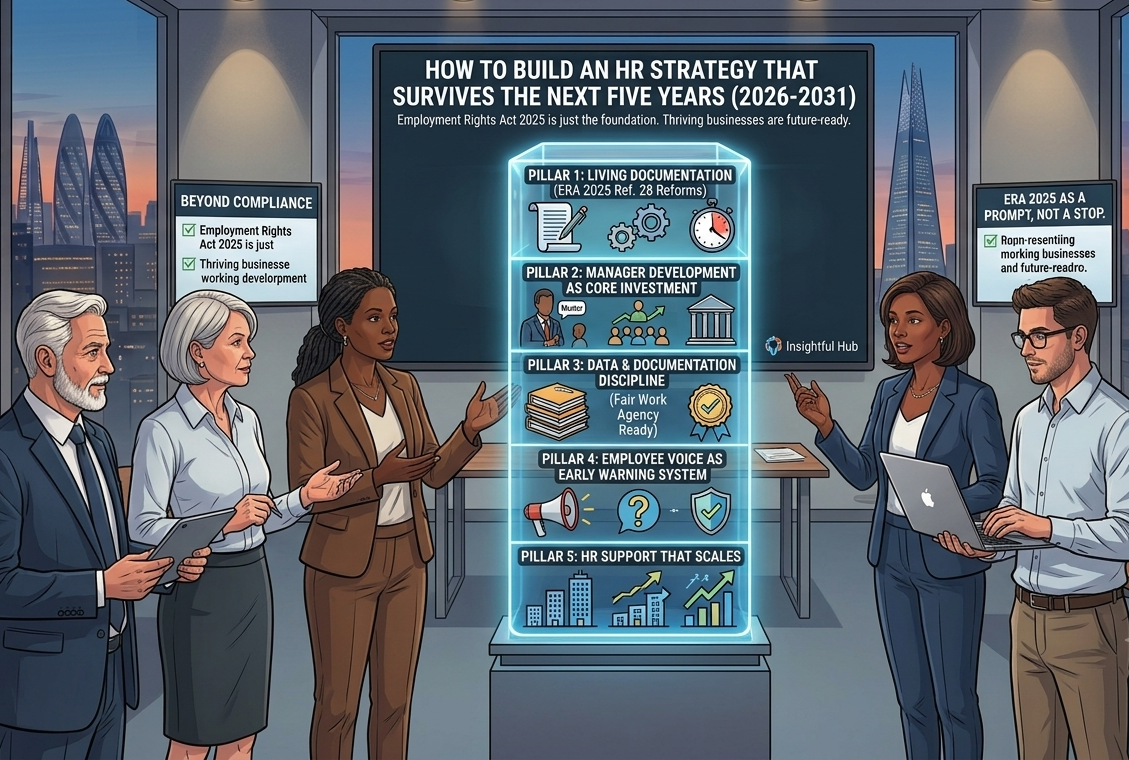
The Employment Rights Act 2025 is a landmark moment for UK employment law. But the businesses that emerge from it strongest will not simply have reacted to the changes. They will have used it as a prompt to build an HR function that is genuinely fit for the future.
The Compliance Trap
When major legislation arrives, the instinct is to focus on compliance. Check the boxes. Update the policies. Move on.
That approach is understandable — and incomplete. Compliance tells you the floor. Strategy tells you where to go next.
The Employment Rights Act 2025 is not just a list of things you need to do. It is a signal about the direction of travel: toward more protection for employees, more transparency from employers, and more accountability for how businesses manage their people.
The businesses that build HR strategies responsive to that direction — rather than simply compliant with the minimum requirement — will have a structural advantage in hiring, retention, and culture for years to come.
Five Pillars of a Future-Ready HR Strategy
1. Living Documentation
Your HR policies, contracts, and procedures are not set-and-forget documents. The Employment Rights Act 2025 alone has introduced 28 reforms. Secondary legislation is still coming. A future-ready HR function requires a clear ownership model for documentation: who is responsible for reviewing policies, when, and in response to what triggers.
2. Manager Development as a Core Business Investment
The compliance failures that reach tribunals rarely happen at the policy level. They happen in the room, in the moment, when a manager makes a decision without the knowledge or tools to make it well. Investing in manager capability is not a soft benefit. It is a hard risk management tool.
3. Data and Documentation Discipline
The Fair Work Agency, which launched in April 2026, has real investigative and enforcement powers. It can request records, issue penalties, and bring claims. Businesses that maintain clear, accurate employment records will be able to respond quickly and confidently. Those that cannot will find that absence of documentation is itself treated as evidence of non-compliance.
4. Employee Voice as an Early Warning System
The ERA 2025 strengthens employee rights across the board. The businesses that fare best in this environment are those that do not wait for employees to exercise their rights formally — they create the conditions for concerns to be raised and addressed early, before they become claims. Regular check-ins, clear grievance channels, and genuine responsiveness to feedback are not soft management practices. They are claim prevention.
5. HR Support That Scales
One of the most significant challenges for SMEs is access to current, expert HR guidance without the cost of a full-time HR director. The model that makes sense for growing businesses is one that provides on-demand expertise, up-to-date resources, and peer learning — at a cost that scales with the size of the business rather than the size of a law firm’s invoice.
The Businesses That Will Thrive
The next five years of UK employment law will not be static. The ERA 2025 is a foundation, not a full stop. Secondary legislation, updated guidance, and further reform are already in the pipeline.
The businesses that thrive in this environment will not be those that react fastest to each new change. They will be the ones that have built the systems, the culture, and the support structures to absorb change — and to see it as a competitive advantage rather than a compliance burden.
That is what a genuine HR strategy looks like in 2026 and beyond.
Ready to Transform Your HR Strategy?
Get expert guidance from our Fractional HR Directors to solve your people challenges and drive business growth.