
Flexible working is no longer a benefit you offer at your discretion. It’s a right your employees can exercise, with specific obligations on you as an employer to respond properly. Here’s where the law actually stands today, and what’s coming next.
Day One Rights Since April 2024 — But Are You Actually Compliant?
It’s worth starting with the rules that are already in force, because this is where most SME compliance gaps sit.
Since April 2024, under the Employment Relations (Flexible Working) Act 2023, the right to request flexible working became a Day One right. From their first day of employment, any employee can submit a flexible working request. They can make up to two requests per year. And employers are already required to:
- Consider every request reasonably
- Consult with the employee before refusing
- Respond within two months of receiving the request
- Base any refusal on one of eight specified statutory grounds (things like the burden of extra costs, an inability to reorganise work, or a detrimental effect on quality or performance)
These obligations aren’t new proposals — they’re live law, and have been for two years. Yet many SMEs are still operating as if flexible working is something to be earned, or are managing requests informally without following the statutory process. That’s a real, current compliance risk — not a future one.
What the Employment Rights Act 2025 Will Add
The Employment Rights Act 2025 received Royal Assent in December 2025 and is being rolled out in phases through 2027. Its flexible working provisions are still going through consultation (the government’s consultation on the changes closed in April 2026), and the reforms are expected to take effect in 2027 — so this is the direction of travel, not yet a new set of obligations you need to meet today.
Once in force, the changes are expected to:
- Introduce a reasonableness test: employers won’t just need to point to one of the eight existing grounds, they’ll need to show it was reasonable to refuse on that ground
- Require employers to explain in writing why a refusal is reasonable, not just which ground it falls under
- Sit alongside wider ERA 2025 reforms — including new guaranteed-hours and shift-notice rules for zero and low-hours workers — that reflect a broader shift toward more predictable, secure working arrangements across the Act (though these are separate provisions with their own phased timeline, also expected in 2027)
The eight statutory grounds for refusal themselves aren’t changing. What’s changing is the burden on employers to justify a refusal against those grounds — and that’s where tribunal risk will increase once the reforms land.
The Practical Challenge for Managers
Flexible working requests often land with line managers before they ever reach HR. And line managers, if not properly briefed, tend to make one of two mistakes:
They informally agree to arrangements without documenting them, creating contractual ambiguity down the line.
They informally reject or discourage requests without following the statutory process, creating legal exposure now.
Both outcomes are problems. Informal agreements can harden into contractual rights that are hard to unpick later. Informal rejections that skip the statutory process — no consultation, no documented grounds, no timely response — can already result in claims under the law as it stands today, regardless of what happens in 2027.
Building a Flexible Working Framework That Works
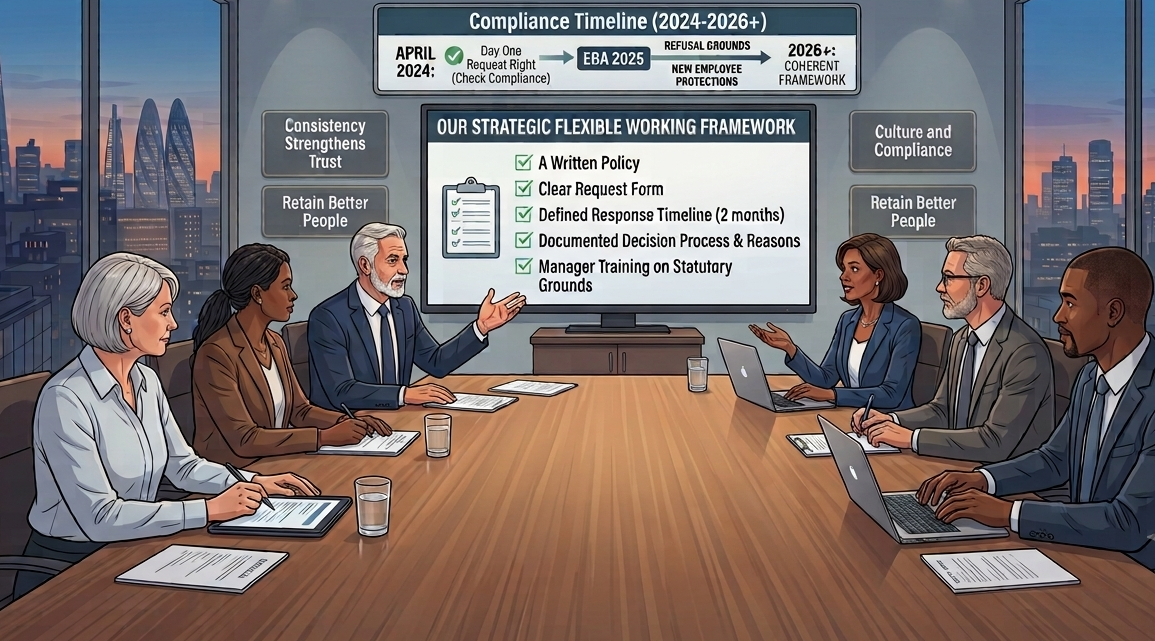
You don’t need to say yes to every request. But you do need a clear, consistent process for handling them, built around the obligations that already apply. That means:
- A written flexible working policy that reflects the current legal framework
- A clear request form so employees know how to submit a request properly
- A defined timeline for response — within two months of receipt
- A documented decision process, including the specific statutory ground(s) relied on for any refusal
- Manager training on the eight statutory grounds for refusal and how to apply them consistently
Getting this right now also puts you ahead of the 2027 reforms — a business that can already show a consistent, well-documented, reasonable process for refusals won’t have far to go to meet the incoming reasonableness test.
The Culture Signal
How you handle flexible working requests sends a signal to your entire team. In a labour market where flexible working is increasingly expected rather than exceptional, businesses that handle these requests fairly, quickly, and transparently will retain and attract better people.
Those that treat it as a nuisance, or manage it inconsistently, will pay the price — in turnover as well as legal risk.
The direction of the Employment Rights Act 2025 reflects what good employment practice already looks like. Businesses that have been doing this well will find the eventual compliance step straightforward. Those that haven’t will need to adapt — and there’s real value in starting that work now rather than waiting for the 2027 deadline to force the issue.
This article is provided for general information and doesn’t constitute legal advice. For guidance on a specific situation, speak to an employment solicitor or HR adviser.
Insightful Hub includes a Flexible Working Policy template, a request form, and a plain-English manager guide — everything you need to handle requests correctly, first time. Access it at insightfulhub.co.uk.
Ready to Transform Your HR Strategy?
Get expert guidance from our Fractional HR Directors to solve your people challenges and drive business growth.