
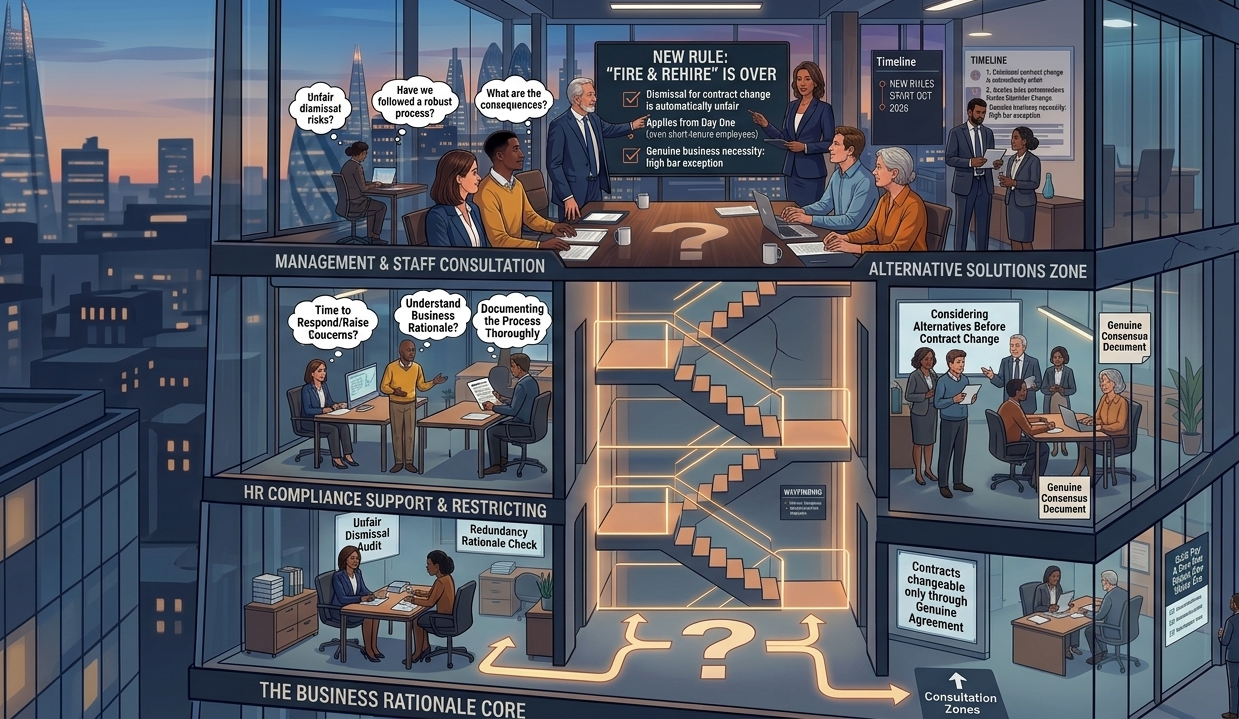
The Employment Rights Act 2025 effectively ends the practice of fire and rehire as a tool for forcing through contract changes. For businesses that have relied on it — or that might have been tempted to — the rules have changed fundamentally.
What Fire and Rehire Actually Means
Fire and rehire, formally known as dismissal and re-engagement, describes a process where an employer dismisses an employee and offers to rehire them on new, usually less favourable, terms. It has been used by some businesses as a mechanism to change employment contracts when employees have refused to agree to the changes voluntarily.
It has been legally controversial for years. Several high-profile cases brought it into public focus, and the Employment Rights Act 2025 responded to that controversy directly.
What the New Rules Say (From October 2026)
From October 2026, dismissal for the purpose of fire and rehire will be automatically unfair in most circumstances. The Act makes clear that:
- Dismissing an employee because they refused to accept a change to their contract will be treated as automatically unfair dismissal
- This applies regardless of the employee’s length of service — even shorter-tenure employees are protected
- There is a very narrow exception where the employer can demonstrate genuine business necessity and has fully consulted, but this bar is set deliberately high
The Wider Message: Consultation, Not Coercion
The fire and rehire reforms are part of a broader theme running through the Employment Rights Act 2025. The Act consistently favours employers who engage genuinely with their people over those who seek to bypass that engagement.
If you need to change employment terms — whether that is pay, hours, location, or working practices — the path forward is genuine consultation. That means:
Explaining the business rationale clearly and honestly.
Allowing employees time to respond and raise concerns.
Considering alternatives before arriving at the conclusion that contract change is necessary.
Documenting the process thoroughly.
It is not just the right approach. From October 2026, it will be the legally required one.
What This Means for Businesses Considering Contract Changes
If you are planning a restructure, a change to terms and conditions, or a shift in working arrangements, you need to think carefully before October 2026 about how you approach it.
Contracts that were previously changeable through pressure or ultimatum now need to be changed through genuine agreement. That requires more time, better communication, and often, external HR support to navigate.
The businesses that will handle this best are those that already have strong communication cultures and trust between management and employees. The businesses most at risk are those that have historically managed change through mandate rather than dialogue.
One More Thing: The Replacement Provision
The Act also provides that it is automatically unfair dismissal if an employer dismisses an employee with the intent to replace them with an external person performing substantially the same role. This closes a loophole that had sometimes been used to justify fire and rehire through a restructuring mechanism.
If you are planning redundancies or restructuring, ensure the rationale is genuine and well-documented, and that you are not inadvertently triggering this provision.
The Bottom Line
October 2026 is not far away. Businesses that rely on contract change as part of their operating model should start reviewing their approach now, well before the new rules take effect. Genuine consultation takes time to build into your processes properly, and starting early gives you room to get it right.
Ready to Transform Your HR Strategy?
Get expert guidance from our Fractional HR Directors to solve your people challenges and drive business growth.