
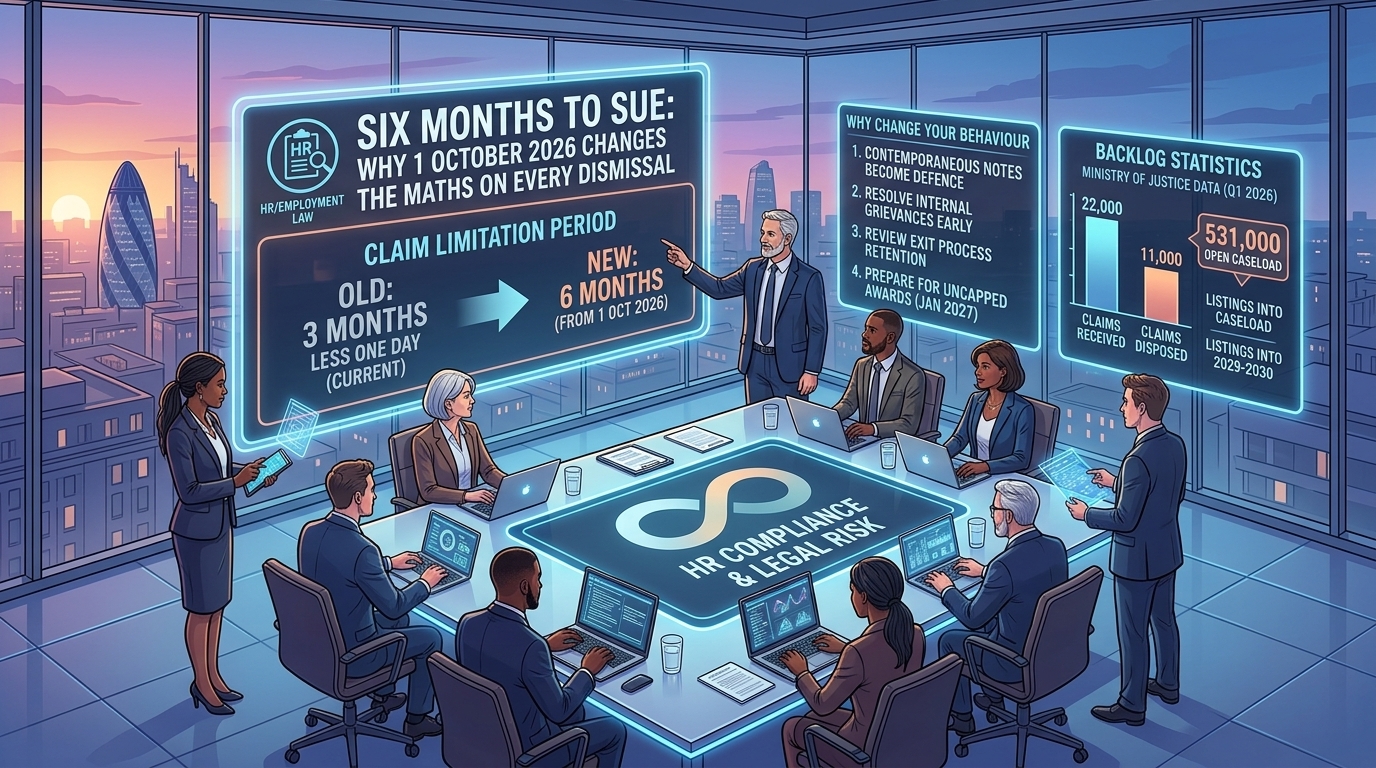
From 1 October 2026, the time limit for bringing most employment tribunal claims doubles from three months to six. Combined with a tribunal system already running at record backlog, it means you could be defending a decision you made almost a year ago — from memory.
What Is Changing
Under the Employment Rights Act 2025, the limitation period for the great majority of employment tribunal claims increases from three months less one day to six months. The change is expected to apply where the relevant events occur on or after 1 October 2026, and it is not retrospective. For breach of employment contract claims in Scotland, the six-month limit takes effect on 9 November 2026.
Wrongful dismissal claims, initially thought to be outside the scope, have since been added to the list.
On paper this looks like an administrative tweak. In practice it changes how long you carry risk, and how much you need to be able to prove.
Six Months Is Not Really Six Months
Before a claim reaches a tribunal, the claimant must notify Acas and go through early conciliation. That process can itself run for up to twelve weeks, and it pauses the clock.
Add the two together and the practical position is this: an employee dismissed in October 2026 could still be bringing a claim the following summer. Employment lawyers are now advising that employers may wait ten to twelve months before they learn a claim exists at all.
Think about what that means for your documentation. The manager who made the decision may have left. The notes of the conversation may never have been written up. The reasoning that felt obvious at the time will have to be reconstructed from whatever survives in writing.
The System Is Already Overwhelmed
The time limit change lands on a tribunal system under serious strain.
Ministry of Justice statistics published on 11 June 2026 covering January to March 2026 show around 22,000 claims received in the quarter against roughly 11,000 disposed of. Receipts have been outpacing disposals for some time, and the open caseload reached approximately 531,000 claims by the end of the quarter.
Comparing 2025/26 with the previous year, single claim receipts rose by 39% while disposals fell by 12%. The open caseload grew by 55%.
Unfair dismissal remains the most common complaint, featuring in more than half of all new claims.
The consequences are visible in listing dates. Shorter hearings in many regions are still being listed within a year or so, but longer hearings are being pushed dramatically further out — five-day hearings in London South have been listed into the first half of 2029, and some regions are reporting listings into 2030. Analysis published by the Work Rights Centre in May 2026 noted that the number of employment judges in post is around 19% below the 2022 level, even as the caseload has grown.
Acas is under matching pressure. It received more than 135,000 early conciliation notifications between April 2025 and February 2026 and was on course for roughly 150,000 across the year — the highest level on record.
Why This Should Change Your Behaviour
1. Contemporaneous notes stop being good practice and start being your defence
If a claim arrives ten months after a dismissal and a hearing follows two years after that, the only version of events that will carry weight is the one written down at the time. Memory is not evidence. A dated, factual note is.
2. The value of early resolution goes up
Both sides now face a longer, more uncertain wait. Acas reports an overall settlement rate of around 29% at conciliation stage. Where a genuine grievance exists, resolving it internally — properly, and early — is now materially cheaper than the alternative for almost everyone.
3. Your exit processes need a longer memory
Six years of holiday records. Six months of limitation. Multi-year listing delays. The direction of travel is unambiguous: keep more, keep it longer, and keep it in a form someone else can find.
4. Uncapped awards arrive three months later
From 1 January 2027, the unfair dismissal qualifying period drops to six months and the cap on the compensatory award is removed. A longer window to claim, a shorter qualifying period and no ceiling on compensation is a combination that rewards process discipline and punishes informality.
What to Do Before October
- Introduce a standard, simple note-taking template for any performance, conduct, grievance or exit conversation — and require it.
- Set a document retention rule that assumes a claim could arrive twelve months after the event and be heard years later.
- Review how you handle leaver files. If a manager departs, their decision records should not depart with them.
- Train managers on what a defensible written record looks like: dates, facts, what was said, what was agreed, what happens next.
- Take internal grievances seriously and resolve them early. The cost of a two-hour conversation now is not comparable to the cost of a hearing in 2029.
The extra three months does not create claims that would not otherwise have been brought. It gives disgruntled ex-employees more time to decide, and gives you far less certainty about when the risk has passed.
Ready to Transform Your HR Strategy?
Get expert guidance from our Fractional HR Directors to solve your people challenges and drive business growth.